Scaffolding the Grant Writing Process
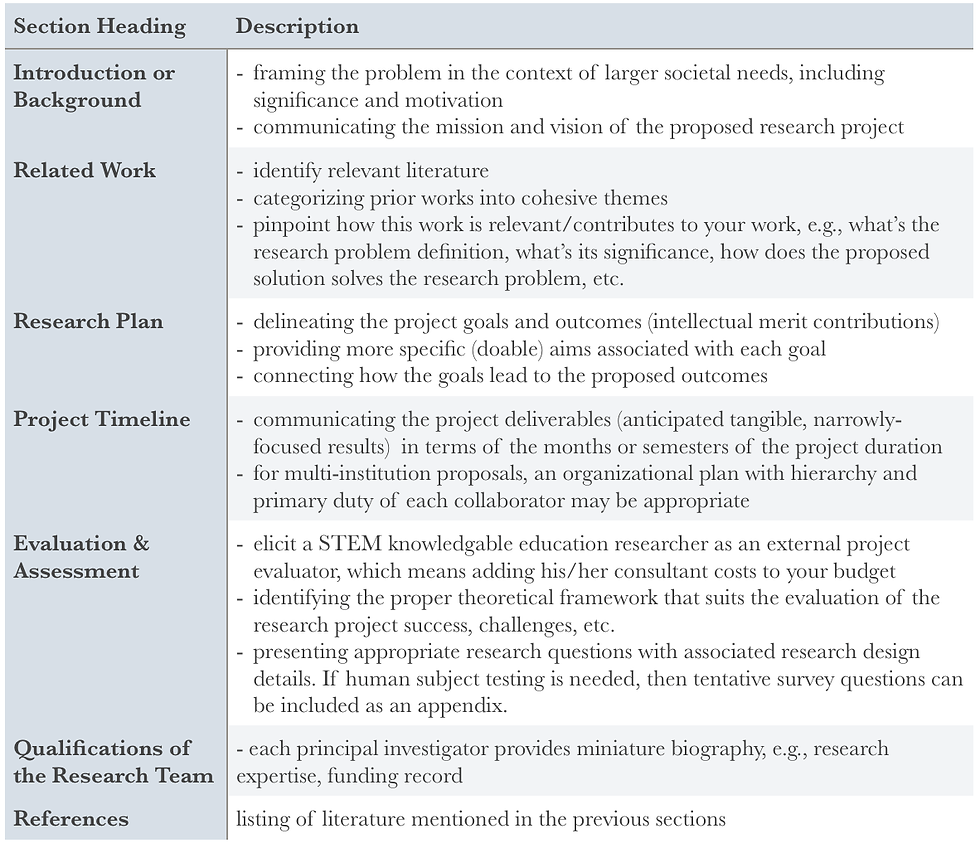
The grant writing and submission process is very much like the research process, e.g., "a meandering slow and fast, exciting and dull, frustrating and rewarding process over time and mostly in collaboration with colleagues”. The discussion of research grants can in no way can be handled sufficiently in a blog post, workshops, books or through human to human conversations. You only learn through experiencing it.
There is having a research project idea, there is effectively communicating that idea and there is receiving money to execute that idea. In the first year as an Assistant Professor, I was utterly blown away by the amount of time, brain-clock-cycles and knowledge about grant writing needed to just complete a proposal - let alone be awarded the funding. A flurry of questions swirled in my brain: How do I write a project summary or project description? What is appropriate to include in the project budget? Why do I need to justify the budget in the facilities, equipment and other resources document? Is there a template for the biographical sketch? Can I see samples of biographical sketches, project summary and project description? Can I even do this? Who can mentor and guide me? I am just not prepared to do this. Why didn’t I learn these skills in graduate school or through my postdoctoral position? Was I just not paying attention?
Ok, OVERWHLEMED!
First, breathe deeply.
Second, continue reading.
I will speak on the National Science Foundation (NSF) funding stream given my familiarity with this government agency as a grant writer, grant awardee and proposal review panelist. NSF is divided into a number of directorates (or discipline-specific funding units), where computing falls into the Computer and Information Science and Engineering (CISE). CISE has 4 divisions: Advanced Cyberinfrastructure (ACI), Computing & Communication Foundations (CCF), Computer and Network Systems (CNS) and Information and Intelligent Systems (IIS). Each division manages grant competitions and funded awards through program directors and officers.
For most grant writers, you are answering a call-for-proposal (CFP) solicitation. Now, I find NSF CFPs to be a cryptic read with some informative content. The General Information provides the list of program officers assigned to the proposal competition - a great point-of-contact to filter your proposal ideas to gauge the appropriateness of your proposal to the CFP. The Proposal Preparation and Submission Instructions tells you if a letter of intent and/or primary proposal is required aside from the full proposal and the associated deadlines. The Introduction and Program Description sections are intended to provide potential proposers’ insight into what NSF is aiming to address. The remaining of the CFP is all about process - award & eligibility information, proposal preparation and submission instructions, review procedures and award administration information. In total, an NSF CFP is about 10 pages with very small print and large side margins.
IMHO, the grant writing process is akin to cooking. A recipe is really just a guideline, a suggestion of how to make food taste great (to the recipe creator). You have a recipe. Most people follow most of the cooking instructions. Most people use most of the ingredients.
Ingredients: 1 very good to excellent idea 1 PI Up to 4 coPIs 1-page project summary Up to a 15-page project description list of cited references Up to 5 PI and coPI biographical sketches 1 data management plan 1 budget document for project duration 1 budget justification 1 facilities, equipment and other document (X) other personnel (post doctoral scholars, graduate students, undergraduate students, etc.) Instructions: Regardless of if you are responding to an CFP or submitting an unsolicited proposal, successful research grants are about having the right people, addressing a timely problem and effectively executing a reasonable implementation plan within the funding timeframe. Start with talking to colleagues within and outside your discipline. People are so creative and discuss some very good approaches to open research problems. The plan can only be achieved when motivated, commonly goal-focused people decide to devise and then implement the plan. Does this sound difficult? Well, yes it is. The people-problem-plan triad is crucial to manage. The overall intent of the grant proposal is to supply clear and sustainable outcomes for your technical community while responding to this discipline’s science needs outlined by the NSF’s CFP and/or mission. The project summary has 3 parts: overview (mission and vision), intellectual merit (contributions) and broader impacts (sustainability). The project description is an expanded version of the project summary with a background, related work, research plan, tentative project timeline, evaluation & assessment, and qualifications of the research team. The budget, budget justification, data management plan and facilities, equipment and other documents are dictated by the NSF CFP, research team, project goals & outcomes. Check out the grant proposal components given in the figure at the top of the article. Consider incorporating them...
Godspeed!
I always appreciate creative work that gives importance to language and meaningful communication. The content feels visheshan ke udaharan approachable, and readers can easily understand the thoughts being shared. Hindi has an incredible range of expressions, making it suitable for describing almost every human emotion. It is encouraging to see collections that celebrate this quality. I hope there will be more fresh and engaging content for people who enjoy reading in Hindi.
The comparison made about grant writing and cooking is interesting, as both activities need good planning and the right ingredients. Simplifying the process by breaking it down into smaller bits makes it easier to handle. The same approach can be applied in all other creative activities as well, including making a proposal for research or selecting affordable embroidered patches uk. Success in any task normally comes through proper planning and handling small details.
This is a helpful guide to breaking down a complex process into manageable steps. Clear planning, collaboration, and strong communication are essential when turning an idea into a successful proposal. Similarly, Australian book publishing companies help authors organise their ideas, refine their manuscripts, and navigate the publishing process, making it easier to turn valuable knowledge and research into a professionally published book.
This is a helpful reminder that grant writing becomes easier when the process is broken into smaller steps. Planning the main ideas, understanding the requirements, and getting feedback can make a real difference. The same approach is useful for students looking for coursework writing services, as good planning and clear writing help them understand complex tasks and organise their ideas. Reviewing each section carefully before submission can also improve the overall quality of the work.
I found this post very relatable, especially the point that grant writing can feel overwhelming without a clear process. I’ve also learned that breaking academic work into smaller steps makes difficult tasks easier to manage. When I need extra guidance, I see assignment help uk as another useful support option for staying organised, focused, and confident throughout academic writing.